poet in exile
View article
View summary
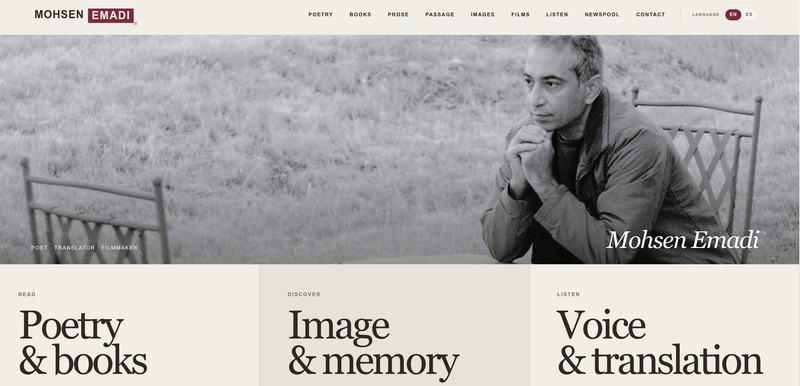
On SoundCloud, the songs, which began with my search for the music of Amir Khusro, the 14th century grandfather of North Indian music, stumbled into a poem, set to music, based on Federico Garcia Lorca by the Iranian Mexico-based poet Mohsen Emadi - the words in Farsi. So this being rather curious, I delved a little further.
Emadi has an attractive
website, in Spanish and English, with links to YouTube, Instagram and
Words Without Borders, where he is also featured. His website includes samples of his poetry, prose, as well as interviews. Emadi is a poet in exile. He describes his heavy feelings of leaving Teheran in an
interview,
I got into a taxi, one hour after making love with my girlfriend. She was left behind like the city. At the airport, the images of the past two months flashed by me—after the Green Movement, the street fights, bullets, deaths, hopes, and despairs—as I gave my mother a last embrace while my sister cried. Yes, in such intensity we lose the sense of comparison. I suppose Tehran itself was the most heartbreaking memory I’ve had. That I still have.
Among the dark memories evoked in his poetry is one that is captured in a composition called simply "The Poem". It is based on a historical event: at about the same time as Khomeini announced the fatwa on Salman Rushdi, he ordered the execution of 5,000 political prisoners.
It was his strategy of distracting the Western media. They were so busy with Rushdie, they overlooked the real issue, innocent people being killed inside Iran. In 2009, the government announced its plan to demolish the cemetery and build a highway. I had a lot of friends whose parents were buried in the cemetery. I wrote “The Poem” about the demolishing of the cemetery and exile seven months before I left Iran. I never imagined it would become so symbolic of my life—now in exile, lost, un-findable.
This poem can be
found on Words without Borders, and it is also the basis of a film he put up on YouTube.
The latter is
embedded in his website, with versions in English and a Spanish. But, at least from my VPN server location, a stark notice appears over the film: "Video Unavailable: It was blocked due to the claimed content by SME". SME turns out to be Sony. So I clicked on Ctrl-U to reveal the html source, found the link, and fed this into Invidio.us, which gave me the ability to watch the film. (
https://inv.nadeko.net/watch?v=2VcfBWf5AZg for the English version).
Set in this way to fast moving, blurry black and white video, the poem acquires visual context. It has some unforgettable lines like:
In my language
every time we suddenly fall silent
a policeman is born.
and it reveals maybe the dilemma of being silenced by exile:
At the border stations
they arrest our tongues.
Our words decay when they cross that line.
Similar feelings are no doubt shared by activists from many other countries who live in forced or self-imposed exile. At home, while you are there, you have a voice, as it were. Away, not so much - at least for those whom you would like to speak to. The poem ends, "My language is silence. Who will translate my silence? How am I to cross this border?"
Hopefully for the poet, this expresses only a single, if prismatic, dimension of life in exile. Emadi says: "Tehran exists in many of my poems. But I am not a poet of Tehran as Nezval was the poet of Prague... I carry Tehran and many other cities within me. " Iran is not an endpoint. Life continues with its river of experiences. One of his poems speaks of his work on the night shift as a toilet cleaner, and of finding a woman drunk and asleep in one of them; others describe unsettling dreams of a surreal quality. Besides his translations of Lorca, there are a surprising number of others, which together with his essays, express an ongoing engagement with world literature, even as he draws upon the folklore and legends from the village of his birth.